Showing posts with label police searches. Show all posts

Monday, January 28, 2013

Racial Profiling & Your Rights

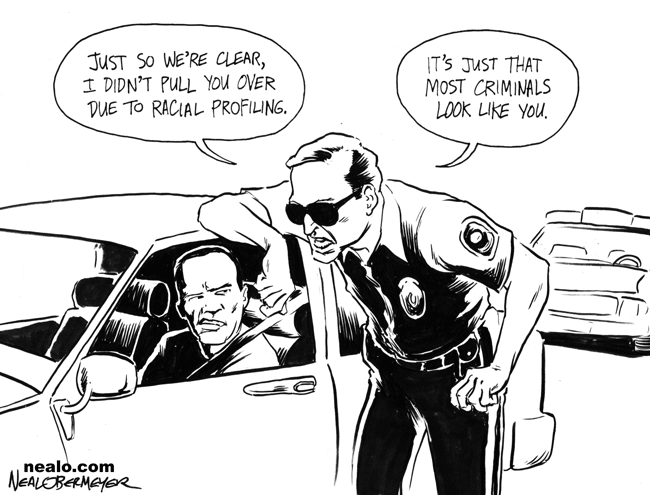
Mark is a sixteen year old African Canadian male who lives in a community considered to be a priority neighborhood.  On Friday night, Mark was walking home alone from his shift as an assistant cook when he was suddenly stopped by two police officers. The officers questioned Mark about an earlier armed robbery that took place three houses down from his. After giving the police all the information they had asked for including information that he just finished work fifteen minutes ago, Mark was advised of his legal rights and arrested for armed robbery. At the time of the arrest, Mark insisted that he had been at work and they could call his boss if they needed to make sure he was telling the truth. When Mark was on route to the police station he asked how the police could assume he was involved in the alleged crime based on the information he gave, the police responded by saying “the crime took place about a half hour ago, you’re dressed like the other accused persons are and who else walks near a crime scene at 12:00 in the morning?” Mark chose not to comment further and was taken into custody where he called his mother upon arrival. Mark believes that the police officers racially profiled him.

http://www.nealo.com/blog/wp-content/or041508-small.gif

What is Racial Profiling?
The Ontario Human Rights Commission defines racial profiling to include any action undertaken for reasons of safety, security or public protection that relies on stereotypes rather than on reasonable suspicion, to single out an individual for greater scrutiny or different treatment. Racial profiling is based on stereotypical assumptions because of one’s race, colour, ethnicity, etc. The Commission has noted that profiling can occur because of a combination of the above factors and that age and/or gender can influence the experience of profiling.

YOUR RIGHTS: 

Stops:
The police can stop you and ask you questions at any time, but unless they are arresting you, detaining you to investigate you for a crime or writing you a ticket, they must let you go if you do not want to talk with them.
You can ask questions like, "Am I free to go?", "Why are you questioning me?" It is important to speak to an officer calmly and to assess the situation. If you are fearful for your safety, it is better to comply with the requests of an officer while saying that you do not consent. You can file a complaint at a later date (see below for more information).

Searches by the Police:
The police can only search you if they have a search warrant, you are being detained and investigated, you are being arrested for allegedly committing an offence or if you give permission to the police. If you are being searched and you think it is unlawful, make sure you communicate that you do not consent to the search but DO NOT physically resist. Make sure to communicate that you want to speak to a lawyer and ask to make the telephone call right then if you have access to a cellphone.

If you believe that a police officer has violated your rights or acted improperly, you should collect as much information about the incident as possible and speak to a lawyer for advice. The lawyer can give you advice on your options and help you make a complaint, make an application to the Human Rights Tribunal, sue the police for damages (money) or report the incident as a crime. You should immediately get and keep as much information about the incident as possible. Try to get the officer’s badge number and division number and write down the date, time and location of the incident.

Office of the Independent Police Review Director (OIPRD)
A new police complaint process started in 2009. If you would like to complain about an incident involving an Ontario police officer that occurred after October 2009, you can make a complaint directly to the police service where you experience the incident or directly to the OIPRD. Discriminatory conduct such as racial profiling is conduct outlined in the Police Service Act Code of Conduct and considered police misconduct. This sort of misconduct can attract disciplinary action for the police who conducted it and the OIPRD may investigate your claim further. For more information click here.

This blog scenario was written by Johnny Stavrou. The legal content of this blog post was written by Lauren Grossman, a first year law student at the University of Toronto who is volunteering at JFCY through her law schools Pro Bono Students Canada program. All legal content was reviewed by a JFCY staff lawyer.



Friday, December 7, 2012

Police Carding


You’re walking home after a long day at school and from the corner of your eye you notice a police cruiser approaching you. You think nothing of it, as you haven’t committed a crime.


Not too long after you hear a whistle, or a “hey you”, from the direction of the cruiser and find the officer inside motioning at you to approach his vehicle. Upon approaching the driver’s side of the car, the officer asks you questions like, “where were you going?” or, “do you have any illegal substances on you”. They continue with justifications for the stop, “you matched the description of a suspect in recent residential thefts”, or “we’re looking for an individual who matches your description”. Finally, they end by asking for your personal identification card, or information like your name, age, and address. 

This policing practice is called “carding”, and is named after the requesting of ID cards that are stored in police records. The Toronto Police are also now calling these types of stops ‘street checks’.  Carding or street checks are an unfortunate reality for many youth, disproportionately so, for young males belonging to ethnic minorities. When an individual is approached by an officer and asked for personal information, the individual can decline to answer as his or her rights are protected under the Charter of Rights and Freedoms, however in reality, failing to answer, or “not cooperating” can lead to greater problems over simply complying with the officer’s demands.  

Also, sometimes the officer has a reason to stop you and the authority to find out who you are.  For example, if there are a number of factors that lead the officer to suspect that you are involved in a particular criminal activity, or if you are being issued a ticket for an offence like trespassing or riding your bike without a bell, the officer has the authority to find out who you are.  If you don’t identify yourself, the officer could take you to the police station to find out who you are.  It is important to find out if you must stay in the presence of the police by asking, ‘am I free to go?’  If you are not free to go, you should also ask ‘why are you stopping me?’  It is up to you if you want to share more information with the police officers but most lawyers will give you the advice that beyond identifying yourself, you have a right to remain silent and say nothing else, regardless of whether your are doing anything wrong or not.  

Why do officers collect personal information from the public?

Also known as the “208” card, the index-size-card is used to gather information about community members. It is often justified as a method to reduce crime in high-risk communities across the city. Police are asked to document their daily practice, and are to be as detailed as possible, which includes taking detailed notes of incidents as they happen, and documenting their interactions with the members of the public. This information is collected on contact cards, and is gathered in the large quantities in communities where the incidents of crime are likely to occur. Also, filling out these contact cards is regarded as good police work; the cards have been used to obtain search warrants, identify witnesses, and even sometimes aiding in trials. The information of these contacts cards are than entered in to large databases that the police use to search for connections, persons of interest, and bystanders of previous crimes. These contact cards will also later be used for reference to future crimes.

Another justification for this practice is that if the job is done right, and all the ‘bad guys’ are removed from the neighbourhood, you will be less vulnerable to victimization. This also means officers will be needed in the neighbourhood, meaning individuals will no longer be carded.

The police have been under heavy scrutiny in Toronto, as well as other large cities such as New York and London, after recent research showing that the police had a tendency to stop racial minorities much more frequently. In Toronto, this practice lead to the Toronto Police Service Board asking the Chief of Police Bill Blair to collect statistics on the rates of different groups being stopped, and to address discriminatory practices. The Board will also soon require police to give out ‘receipts’ or copies of the card stating the purpose of the stop to each individual carded.  

On November 14th, 2012, Justice for Children and Youth made a written submission and presentation to the Toronto Police Service Board about Toronto Police Service discrimination and carding practices.  See the written submission here and link to video here.

This post was written by JFCY volunteer Shawn Malik, a member of the PLE Team.  JFCY's Street Youth Legal Services lawyer, Johanna Macdonald, added some info and expertise.

Tuesday, June 12, 2012

Pot: What is the law?


Scenario:

Jeremy, 17, and his friends are excited to go to a big house party. Jeremy’s parents have even lent Jeremy their car for the evening on the condition that he not consume any drugs or alcohol. Along the way to the party, Jeremy stops to pick up his friend Jonathan. As Jonathan approaches the car, he pulls out a few small bags of weed and says to Jeremy “we are going to get sooo stoned tonight!” Jeremy, usually a good boy, decides to take a  small bag and put it in his pocket.  He doesn't plan on smoking it but doesn't want to look like a loser in front of his friends. Jeremy lets Jonathan smoke some weed en route to the party.

The two boys are stopped by the police for driving with a broken taillight. When the police officer approaches the car, she smells burnt marijuana and demands the boys exit the car. After a “pat down” search of Jonathan’s clothes, the officer discovers the bag of weed in one of Jonathan’s pockets.

QUESTION:

Can Jeremy be found guilty of possession even though he did not intend to use the drugs? Did the officer have the right to search inside Jeremy and Jonathan’s pockets?

Answer: Jeremy may be found guilty of possession even without the intention of using the weed. He had the drugs in his pocket and thus they were in his possession. (See s. 4(3)(b) of the Criminal Code.) 

Answer: the legitimacy of the search of Jonathan’s pocket depends on whether or not the officer had “reasonable grounds” to suspect Jonathan was committing an offence. (See s.495 of the Criminal Code.) Odour may form the basis of a reasonable suspicion. (To read a court case about this click here.)

MORE ON MARIJUANA AND THE LAW

Marijuana is the most commonly used illicit drug in Canada. Over 10 million Canadians are estimated to have used marijuana at least once in their lives. Although some advocacy groups continue to push for its decriminalization, marijuana and its derivatives remain illegal under the Controlled Drugs and Substances Act (CDSA).

There are legal consequences of possessing and distributing marijuana. Below is as a description of the charges, and examples of punishable activity, as well as some info on your rights during police searches.

CHARGE: Possession of marijuana

In the CDSA the definition of drug possession is borrowed from section 4(3) of the Criminal Code of Canada.   “Possess” means to have the drug on your person, but you may also be charged with possession if someone else is holding the drug for you or if you have it stashed someplace for future use. 

CHARGE: Trafficking of marijuana

The definition of “trafficking” under the CDSA is very broad. To traffic marijuana is “to sell, administer, give, transfer, transport, send or deliver the substance...” or to sell an authorization to purchase marijuana.  Selling does not require payment in exchange for the drug. Any kind of transporting/delivering, offer of sale and distribution –even if not in exchange for anything –can fall under trafficking. Consider a situation where a group of friends get together and smoke Marijuana that one person “picked up”. The individual who shared the drug has 'trafficked' regardless whether he asked his friends to pay or not.

You need not actually commit the crime of trafficking in order to be punished for more than mere possession. Possession for the purposes of trafficking is often punished just as heavily as actual trafficking.


Marijuana-related searches

Everyone has a right not to be “unreasonably” searched, but a police officer may search you with or without a warrant, provided there are reasonable grounds to believe you are in possession of a controlled substance. Where a police officer conducts a search without a warrant, s/he must justify the search afterwards in order to use the evidence obtained. 

There must be some factual basis for suspicion in order to justify the search. This might be a tip from an informant or something the police observed. Your reputation and criminal record are also admissible pieces of information the police may use to establish reasonable suspicion.

You can legally refuse consent to be searched, regardless to how many requests the police officers make to search you or enter your home or vehicle. However, the police may refuse to allow you entry into a restricted area unless you consent to a search.

Giving them voluntary consent makes police searches automatically legal.

In public, police can request you to stop and engage you in a conversation . Police can legally use false pretenses (lie), use intimidation techniques, and steadily attempt to persuade you into giving them permission for a search. But until they formally arrest you, you have a right to refuse consent for a search and walk away from them. It helps to remain respectful, to identify yourself, and avoid making quick movements (especially towards the pockets!). Avoiding having Marijuana in public, of course, helps.

If an arrest is made, remember that you have the right to remain silent and insist to speak with a lawyer.

For more info on your rights during a police stop or search, check out JFCY’s resources here: http://www.jfcy.org/ycj-police.html

This post was written by JFCY PLE Team Volunteer Shawn Malik and JFCY summer law student Robin McNamara.  Legal info was reviewed by JFCY.


Photo Sources: