Showing posts with label Search. Show all posts

Monday, January 28, 2013

Racial Profiling & Your Rights

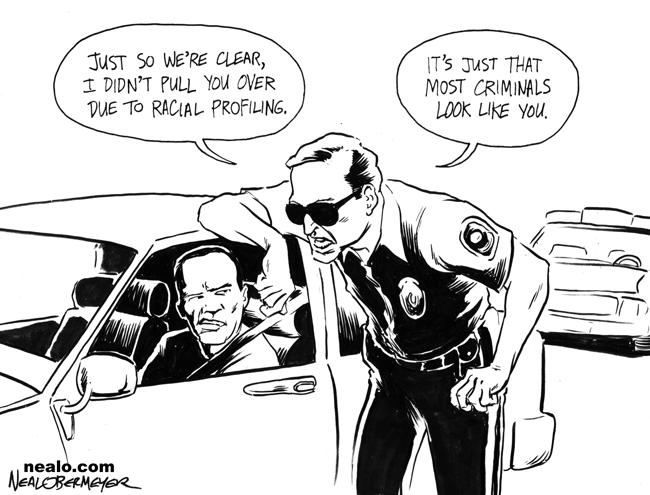
Mark is a sixteen year old African Canadian male who lives in a community considered to be a priority neighborhood.  On Friday night, Mark was walking home alone from his shift as an assistant cook when he was suddenly stopped by two police officers. The officers questioned Mark about an earlier armed robbery that took place three houses down from his. After giving the police all the information they had asked for including information that he just finished work fifteen minutes ago, Mark was advised of his legal rights and arrested for armed robbery. At the time of the arrest, Mark insisted that he had been at work and they could call his boss if they needed to make sure he was telling the truth. When Mark was on route to the police station he asked how the police could assume he was involved in the alleged crime based on the information he gave, the police responded by saying “the crime took place about a half hour ago, you’re dressed like the other accused persons are and who else walks near a crime scene at 12:00 in the morning?” Mark chose not to comment further and was taken into custody where he called his mother upon arrival. Mark believes that the police officers racially profiled him.

http://www.nealo.com/blog/wp-content/or041508-small.gif

What is Racial Profiling?
The Ontario Human Rights Commission defines racial profiling to include any action undertaken for reasons of safety, security or public protection that relies on stereotypes rather than on reasonable suspicion, to single out an individual for greater scrutiny or different treatment. Racial profiling is based on stereotypical assumptions because of one’s race, colour, ethnicity, etc. The Commission has noted that profiling can occur because of a combination of the above factors and that age and/or gender can influence the experience of profiling.

YOUR RIGHTS: 

Stops:
The police can stop you and ask you questions at any time, but unless they are arresting you, detaining you to investigate you for a crime or writing you a ticket, they must let you go if you do not want to talk with them.
You can ask questions like, "Am I free to go?", "Why are you questioning me?" It is important to speak to an officer calmly and to assess the situation. If you are fearful for your safety, it is better to comply with the requests of an officer while saying that you do not consent. You can file a complaint at a later date (see below for more information).

Searches by the Police:
The police can only search you if they have a search warrant, you are being detained and investigated, you are being arrested for allegedly committing an offence or if you give permission to the police. If you are being searched and you think it is unlawful, make sure you communicate that you do not consent to the search but DO NOT physically resist. Make sure to communicate that you want to speak to a lawyer and ask to make the telephone call right then if you have access to a cellphone.

If you believe that a police officer has violated your rights or acted improperly, you should collect as much information about the incident as possible and speak to a lawyer for advice. The lawyer can give you advice on your options and help you make a complaint, make an application to the Human Rights Tribunal, sue the police for damages (money) or report the incident as a crime. You should immediately get and keep as much information about the incident as possible. Try to get the officer’s badge number and division number and write down the date, time and location of the incident.

Office of the Independent Police Review Director (OIPRD)
A new police complaint process started in 2009. If you would like to complain about an incident involving an Ontario police officer that occurred after October 2009, you can make a complaint directly to the police service where you experience the incident or directly to the OIPRD. Discriminatory conduct such as racial profiling is conduct outlined in the Police Service Act Code of Conduct and considered police misconduct. This sort of misconduct can attract disciplinary action for the police who conducted it and the OIPRD may investigate your claim further. For more information click here.

This blog scenario was written by Johnny Stavrou. The legal content of this blog post was written by Lauren Grossman, a first year law student at the University of Toronto who is volunteering at JFCY through her law schools Pro Bono Students Canada program. All legal content was reviewed by a JFCY staff lawyer.




Friday, December 3, 2010

Youth and the Police

What to do if you are being questioned by the police:
Ask if you are free to go and why you are being questioned. If you are being searched, ask why. State that you want to speak to your lawyer. Make the telephone call right then if you have a cellphone. The Justice for Children and Youth GTA number is 416-920-1633.

What to do if you are being searched by the police: 
Police can only legally search you:
  •  if you consent 
  • OR they have a warrant 
  • OR they are investigating your for a crime they suspect you did and it is for safety reasons 
  • OR they are arresting you for a crime and they are searching for evidence linked to the crime.
If the police begin to search you or your belonging without reasons DO NOT RESIST. Say that you do not consent to the search. Remember that the police checking your name on their computer or getting you to empty your pockets is a search.

Under 18? Questioned or Arrested by Police? Here is a Step-by-Step
  1. You should give your correct name, age and address. Ask if you are free to go. If they say no, they may be arresting you. 
  2. Ask why you are being arrested. You have a right to know. 
  3. Before the police can charge you, they must consider the following alternatives. They can:
    • Let you go.
    • Give you a warning
    • Caution you (and even your parents) on the spot or at the police station
    • If there are grounds for a charge, and if you agree, refer you to a community program. 
  4. If the officer does not mention these alternatives, politely ask about the alternatives. 
  5. You have the right to call a lawyer AND a parent or adult that you trust. The police must give you the phone number for a lawyer. You get as many calls as you need. 
  6. Get advice from a lawyer before you say anything to the police. You have a right to have a lawyer with you if you decided to say anything. 
  7. The police can't carry out threats or promises to make you say or write anything. 
Resources:
24 hour Legal Aid Lawyers 1-800-268-8326
Justice for Children and Youth 
416-920-1633 (inside GTA)
1-866-999-5329